Why Are Valuation Fees Lower in Romania Than in Other European Markets
Analysis by Cristian Negrea, Head of Valuation Department, Activ Property Services
In discussions about the valuation market in Romania, the same explanation often comes up when talking about low fees: there are too many authorized valuers, competition is high, and prices are therefore driven down.
At first glance, it seems like a logical explanation. However, a comparison with other European markets suggests that the number of valuers alone is not enough to explain why valuation fees in Romania are significantly lower.
The issue seems to be more closely related to the way valuation services are perceived and purchased.
How much does a valuation report cost in Romania and across Europe?
An indicative comparison across several European markets reveals significant differences in the fees charged for valuation services.
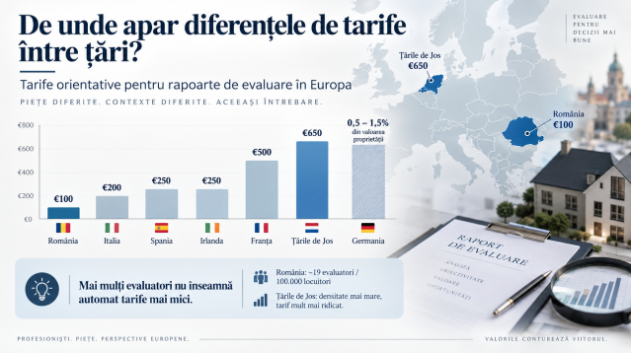
As an order of magnitude, the analysis points to fees starting at around EUR 100 in Romania, compared with approximately EUR 200 in Italy, EUR 250 in Spain and Ireland, EUR 500 in France, and around EUR 650 in the Netherlands. In Germany, for certain types of valuation reports, the fee may also be linked to the value of the property, with indicative levels of approximately 0.5–1.5% of the property value.
These figures should not be interpreted as official or mandatory fees. The types of reports, regulatory frameworks, purpose of valuation, and pricing systems differ from one country to another. Even so, the difference in scale remains relevant.
A professional service that may start at around EUR 100 in Romania can cost several times more in other European markets.
Are there too many valuers in Romania?
Romania does indeed have a relatively high density of authorized valuers in relation to its population. According to the analysis carried out by Cristian Negrea, the figure stands at around 19 valuers per 100,000 inhabitants.
It would be easy to conclude that a high supply of valuation services automatically leads to lower fees. However, the experience of other markets shows that this relationship does not always hold true.
The Netherlands provides a relevant example. In the comparative analysis, the Dutch market has a high density of professionals in the field, yet the indicative cost of a valuation report is considerably higher than in Romania.
Therefore, the explanation that “more valuers automatically means lower fees” does not fully reflect the reality of the market.
What does a client actually buy when commissioning a valuation?
A valuation report is not simply a PDF document with a value stated at the end.
The client is paying for market analysis, the valuer’s experience, the independence of the opinion, the time required for research and documentation, and the professional responsibility attached to the conclusions of the report.
A valuation report may support bank financing, a real estate transaction, an investment decision, financial reporting, or an operation involving assets worth millions of euros.
The problem arises when the service is perceived primarily as an administrative formality.
“We need a valuation. How quickly can you deliver it and how much does it cost?”
From that point on, the selection of the valuer risks being reduced to two criteria: the fastest and the cheapest.
Why can competition based solely on price affect the valuation market?
When clients do not perceive meaningful differences between the services offered by valuers, price inevitably becomes the main selection criterion.
One valuer quotes EUR 150. Another offers EUR 120. The next one quotes EUR 100.
At some point, however, an economic issue arises: for a report delivered at a very low fee to remain profitable, the amount of time allocated to the assignment must be reduced. A constant reduction in the available time may encourage an increasingly standardized approach to the valuation process.
And the more similar the reports appear to the client, the fewer reasons there are to choose a provider based on anything other than price.
This creates a difficult cycle to break: low fees – less time – services perceived as similar – even greater pressure on price.
The price of a valuation and the economic value of the decision are two different things
Let us take a simple example.
A valuer is assessing an asset worth EUR 5 million. A variation of just 5% in the opinion of value represents EUR 250,000.
In this context, the difference between a fee of EUR 300 and one of EUR 600 becomes very small compared with the economic impact of the decision that the valuation report may support.
Despite this, valuation services are sometimes negotiated over differences of just a few dozen euros.
This is one of the paradoxes of the profession: the economic impact of the valuation opinion can be very significant, while the cost of the analysis behind that opinion is constantly pushed downward.
Should all valuations cost the same?
No. And this is where another important issue arises.
The valuation of a standard apartment and the valuation of a commercial building or a property portfolio worth tens of millions of euros do not involve the same workload, level of complexity, or degree of professional responsibility.
The model used in certain segments of the German market is interesting precisely because it creates a link between the value of the property, the complexity of the assignment, and the level of the fee.
This model does not necessarily need to be transferred directly to Romania. The principle behind it, however, is worth considering: the complexity, responsibility, and economic significance of a valuation should also be reflected in the way the professional is remunerated.
What is the real issue in the Romanian valuation market?
Perhaps the question should not be “Why are there so many valuers?” but rather:
Why are valuation services so often purchased almost exclusively based on price?
And there is a second, equally important question: what can the profession do to help clients understand the difference between one valuation report and another?
The responsibility does not lie solely with clients.
If valuers present their services as a standardized commodity, the market will eventually buy them as a standardized commodity. If, instead, they explain more clearly the analysis, experience, responsibility, and professional risk behind an opinion of value, the conversation can gradually shift from “How cheap is it?” to “What value am I receiving for this fee?”
The comparison with other European markets suggests that the number of valuers is not the only factor determining fee levels.
Perhaps the real difference is not how much competition exists in the market, but what professionals choose to compete on: price or the value of the service they provide.